Spinning mill
Spinning is an ancient craft that was once carried out entirely by hand. In 1530, the first flyer spinning wheel driven by a foot pedal was developed. This spinning wheel – an early form of the spinning machine – was able to twist the yarn and wind it onto a bobbin at the same time.
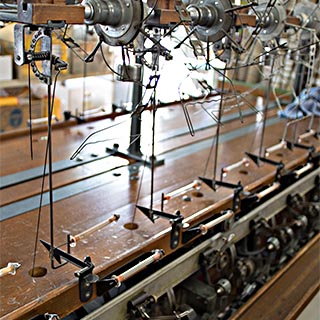
In the 18th century, the first mechanical spinning machines were developed in England and continuously improved over time. Today, there are two main types of spinning machines: the flyer and ring spinning machine, and the carriage (or mule) spinner.
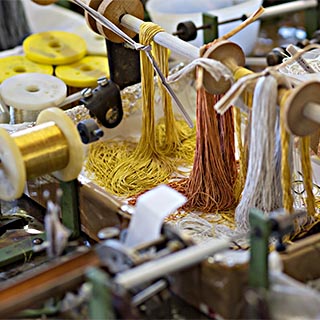
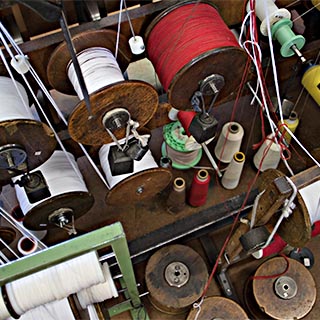
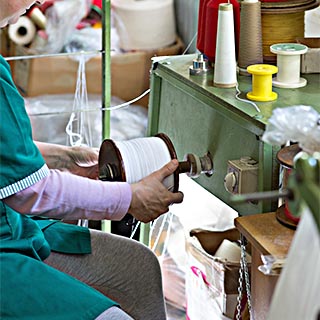
Modern machines operate at impressive speeds: a wire spool rotates around a textile thread at up to 6,000 revolutions per minute, wrapping it in such a way that the core is completely covered by the outer layer. This technique allows threads to be coated with gold, silver, or other materials – the possibilities are virtually endless.
Our products:
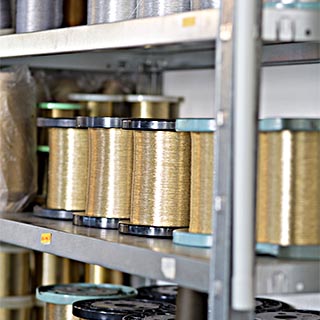
- Bouillon (e.g. for paramentics)
- Threads and wires for uniforms (silver-plated, gold-plated and leonic)
- Wires (silver-plated, gold-plated and leonic)
- Gossamer for a wide range of applications
The right fit for every purpose
Our trimmings are highly versatile. Choose your application - we will guide you to the right selection.